

Should I Study Art?
The kindest lie I tell

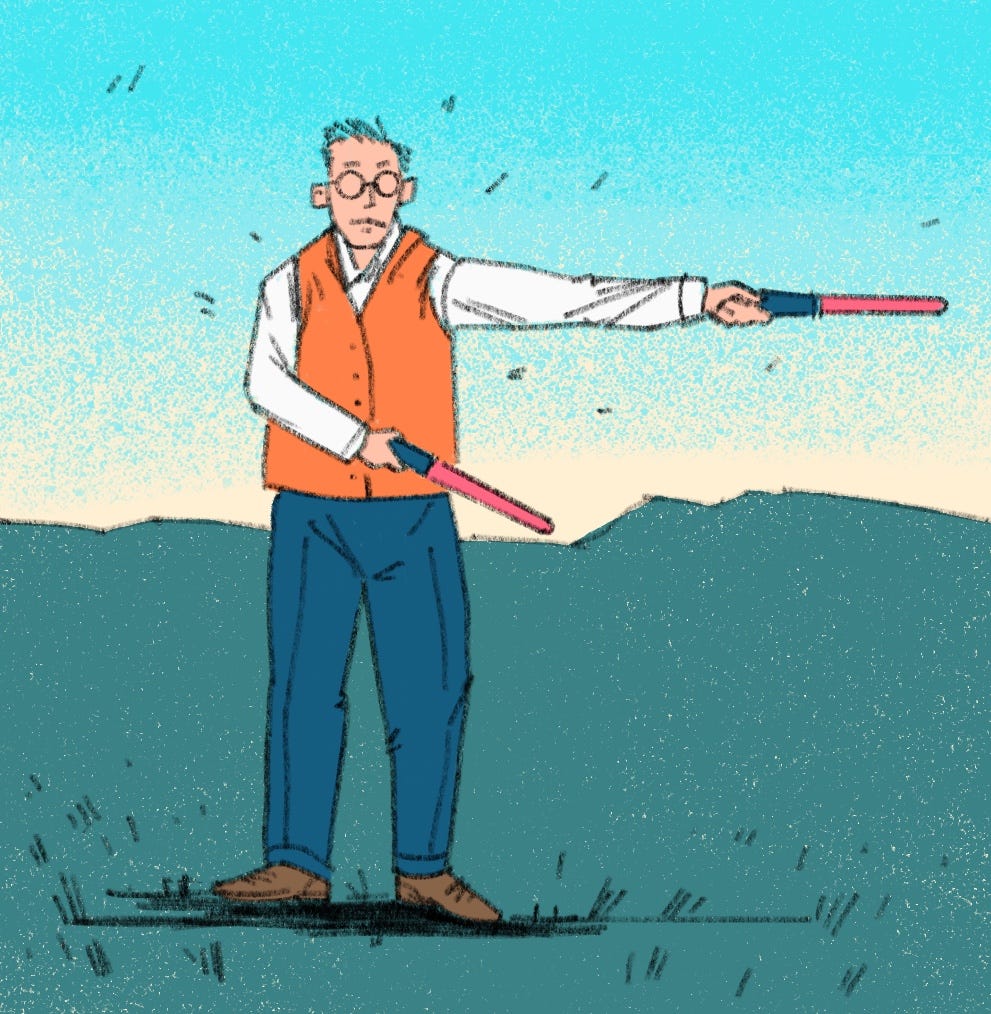
A student makes an appointment to meet with me and discuss their future in the arts. They are earnest, eager, and since they have taken the time to schedule an appointment, responsible. They are often cheerful as they come in and sit down on the other side of my desk.
I welcome them and ask them to remind me of their name. Then they tell me how they want to be an illustrator, how they love to draw and have been doing it since they were young and whether that will be a good choice for them, or should they study something else, like graphic design. In fact, I made a similar appointment in 1988 during my freshman year of college trying to suss out the viability of a path in the arts.
I hate these conversations.
I want to lean over to my bookshelf and grab a copy of the Illustrator’s Workbook. If you are unfamiliar, it is a large and thick book whose pages are laden with illustrators looking for work. Agencies and independent illustrators basically pay to advertise in this heavy tome which is sent out to art directors and art buyers across the country. It comes out every year, and frankly it is depressing. Another response that creeps into my brain, but not my lips, is that in 2023 approximately 1,900 people graduated in the United States with a bachelor’s degree specifically in illustration1. So by the time this student in front of me is graduating, nearly 8,000 illustration graduates will have joined the hunt for the rare opportunities in this profession. I also don’t mention that if they were smart, or practical, they should make the pursuit of art a hobby after they have secured their financial future doing something that will build wealth and security — hopefully where someone contributes to a retirement plan and offers health benefits.
I get that there is no real security in most fields. Except maybe mortuary science. But the reality is like professional sports. You have to be freakishly good, and even that doesn’t secure success — it just improves your odds.
The numbers don’t exactly inspire confidence. The Bureau of Labor Statistics reports that overall employment of craft and fine artists — the category that includes illustrators — is projected to show little or no change through 2034, with only about 4,400 openings nationally each year, most of them simply replacing people who retire or leave. The median annual wage for the field was $56,260 in 20242, which sounds reasonable until you learn that surveys of children's book illustrators suggest nearly half earn less than $10,000 a year from their illustration work alone. Meanwhile, the editorial illustration market has actually declined in recent years due to magazine budget cuts — one of the traditional entry points for new talent. And now, as if the math weren't already discouraging enough, the Association of Illustrators surveyed nearly 7,000 illustrators and found that one in three have already lost work to AI — costing them an average of $12,500 in wages."3
Say what you will about this guy, but NYU business professor Scott Galloway puts it about as plainly as anyone has: “Believing you have to be passionate about something before embarking on the uphill journey to mastery will lead you to careers where the supply of eager workers far exceeds the demand — activities better suited to be avocations than careers. Only 2% of professional actors make a living from their craft, the top 1% of musicians garner 77% of the revenue in the industry, and half of all visual artists obtain less than 10% of their earnings from their art.”4 He also offers this observation, which I find myself thinking about every time a student sits down across from me: “If someone tells you to follow your passion, it means they’re already rich.”
There is also the uncomfortable reality that I am not exactly a disinterested party in this conversation. Low enrollment means cancelled classes. Cancelled classes means a reduced course load. A reduced course load, eventually, means I am looking for work myself. So there is a quiet, institutional pressure at my back nudging me toward encouragement — a conflict of interest I try to ignore but cannot pretend isn’t there.
My kids who studied nursing got jobs right as they left college. My art graduates, well, I plead with them to not quit their current day job for at least five years.
And yet.
When I spend a day at the easel or drawing desk, there is tremendous satisfaction. Something settles and feels, for lack of a better word, right. That part is real as much as the employment statistics, and I never want to pretend otherwise, especially to the student sitting across from me.
I have lived this life and know what it costs: the years living hand to mouth, the miniscule retirement account, the quiet dread that comes with unexpected medical bills in a country that has few options for people who work the way artists work. I know what it means to feel, on certain difficult days, that choosing this path was an act of indulgence and that I asked the people who love me to absorb risks they never fully signed up for. Those feelings are real too.
So when I soften my words at the end of these appointments, it isn’t purely institutional self-interest or cowardice. It is also this: I genuinely do not want to be the person who talked someone out of a life that might have been exactly right for them. Our world needs people stubborn enough to make art in spite of everything. I just want them to go in with open eyes because the ones who survive this path tend to be not only talented and passionate, but a little ruthless about the practical realities bearing down on them.
I didn’t go into this to discourage anyone. I went into it because making art mattered to me more than almost anything and still does. That’s the most honest thing I can tell them — and maybe it’s more useful than any statistic I could pull off the shelf.
So I try to offer something serious and soften it with the line, “It's up to you, and if you work hard and are passionate, you just might succeed.” Hell, it might be true for them and I want to be encouraging, just as my professor was so long ago. Then I drive home wishing I had said something more honest — and conflicted that I didn't.
Source: Data USA, “Illustration,” based on IPEDS Completions data, U.S. Department of Education, 2023. https://datausa.io/profile/cip/illustration
Source: U.S. Bureau of Labor Statistics, Occupational Outlook Handbook, “Craft and Fine Artists,” last modified 2024. https://www.bls.gov/ooh/arts-and-design/craft-and-fine-artists.htm
Source: Association of Illustrators (AOI) survey, as reported by BrainFacts.org, August 2025. https://www.brainfacts.org/neuroscience-in-society/the-arts-and-the-brain/2025/how-will-ai-affect-the-arts-081325
Galloway, Scott. The Algebra of Wealth: A Simple Formula for Financial Security. Portfolio/Penguin Random House, 2024.
Thank you for your honesty in this post. I found the statistics fascinating. I have a son (who’s only 11) that wants to be an author-illustrator when he grows up. It’s a hard balance trying to encourage while also recognizing how difficult that path may be for him when he’s old enough. Luckily there’s still lots of time so I lean into the encouragement of his creativity. Thank you for your transparency in your writing. I always look forward to the insights in your posts.
So hopeful; so painful. It’s too easy to die from exposure on the internet. I’ve landed my dream job for the summer. But it’s one more avenue that doesn’t pay; just death by exposure with a smile. Secretly, I know it’s a summer fling, a romance that will end without commitment, and as soon as it’s over I’ll need to find something else. (Which I should be doing now, but….) Heartbreaking and a relief at the same time because I’m learning that I’m not good at EVERYTHING it takes to make it as an artist—which is a lot, and takes more energy than I have. That said, an illustration degree wasn’t a waste for me. I’m grateful for the skills I learned, the opportunities it’s given me, the people I’ve crossed paths with. Doors are open to me that were not open when I didn’t have a degree; not to mention how it’s helped me see myself. I don’t regret it at all—I just need to add to it—and maybe that’s the answer: encouraging pairing an art degree with __.